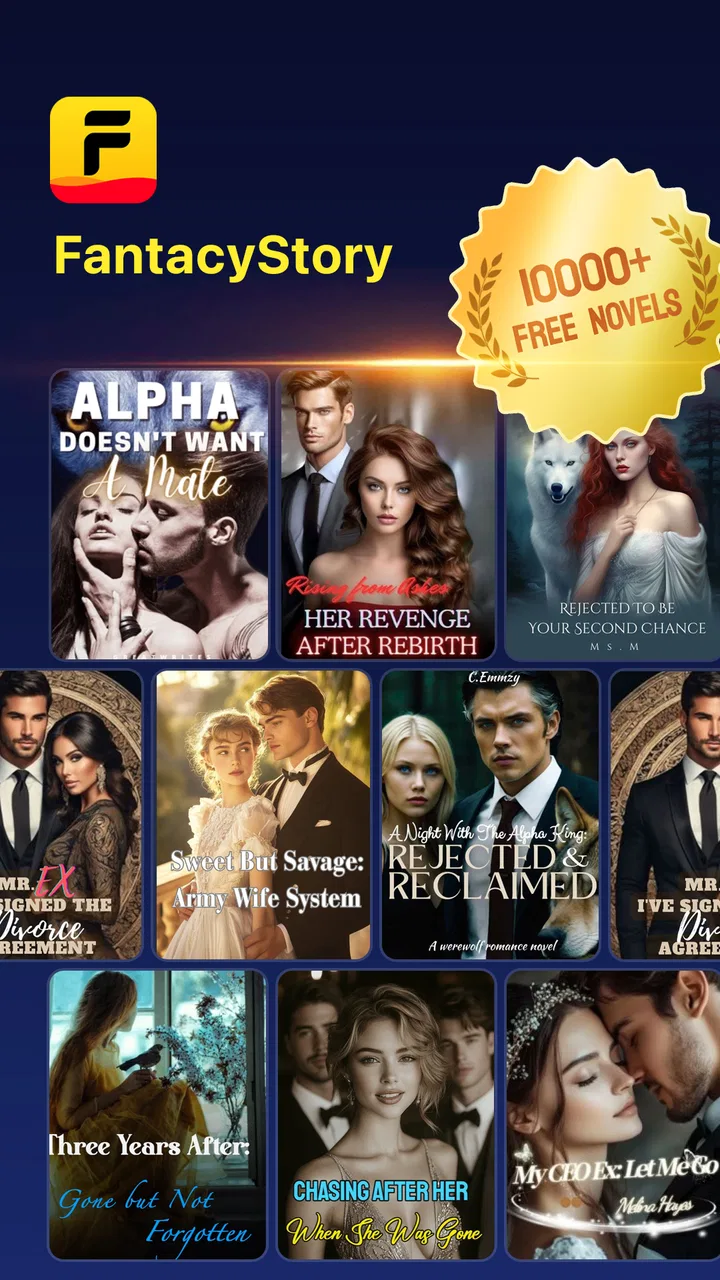
FantacyStory: novels, fictions
- 4.6
- Rating
- 1.00M
- Installs
- Free
- Price

 Analysis by App-foxy
I spent time with FantacyStory: novels, fictions as a mobile reading app, and my first impression was that it is built for people who want fiction close at hand rather than a complicated digital library. It sits in the Books & Reference category, comes from Novel Studio, and is free to install. The central idea is simple: open the app, find a story that matches your mood, and keep reading whenever you have a few spare minutes.
That simplicity is its strongest quality, but it also shapes the experience. This is not the kind of app I would choose when I want a carefully curated academic reference shelf, a powerful document manager, or a reading tool designed around books I already own. I see it more as a discovery-focused fiction companion. The store summary promises access to millions of novels and unlimited reading, while the short description calls it “FantacyStory,” so the app clearly aims at readers who enjoy browsing through a large stream of imaginative stories.
After using it, I would recommend approaching it with a repeatable reading habit instead of opening it randomly and hoping the perfect novel appears. A few minutes spent learning how you personally browse, pause, and return to stories makes the experience much smoother. The best results come from treating the app as a daily fiction shelf, not as a replacement for every kind of reading service.
You May Also Like

 Blood Strike: 2.5 Anniversary
Blood Strike’s Loadouts Turn Every Drop Into a Tactical Gamble
A close look at Blood Strike’s custom loadouts: how fast access to signature weapons reshapes its battle royale rhythm, rewards preparation, and narrows the gap between fights.

 Pandora - Music & Podcasts
Pandora’s Music Is Easy to Start, but Harder to Recover
Pandora’s strength is its low-effort path from a seed to a station. Its weak spot is how much confidence it asks you to place in connection, setup, and quiet recovery.

 8 Ball Pool
 Is Built on Rivalries, Rematches, and Routine
A close look at the rivalries, rematches, shared routines, and unanswered safety questions that turn a quick pool match into a persistent mobile community.

 Samsung Music
’s Quiet Strength Is Playing What You Already Own
Its reach comes less from spectacle than from dependable access to a personal library. That simplicity is both the app’s strongest retention engine and its ceiling.

 AccuWeather: Weather Radar
AccuWeather Review: A Quick, Clear Forecast for Everyday Decisions
For everyday plans, the best forecast is the one you can understand quickly. AccuWeather makes rain timing, radar, and local conditions easy to act on, with a few trade-offs.

 Hill Climb Racing
Why Hill Climb Racing Still Turns Crashes Into One More Run
A tiny car, a bumpy hill and one more upgrade: Hill Climb Racing keeps resurfacing because its simple chaos makes every near-miss feel personal.
More From Our News Desk



How I settled into a practical reading routine
I found that the easiest way to make a broad fiction app feel manageable is to decide what I want from a reading session before I open it: continue a familiar story, or spend time discovering something new. That small choice keeps a quick break from becoming a long browsing session. Once that routine feels natural, the next useful step is to adjust the reading environment to suit different times of day.
Starting with discovery instead of searching too narrowly
My normal first step was to browse rather than search for one exact title. That works well with an app built around a broad collection, because the pleasure is often in finding a story I had not planned to read. I looked for a promising premise, opened a story to judge the writing and pacing, and then decided whether it deserved more of my time. This is a better approach than committing immediately just because a cover or title catches my eye.
For a new user, I suggest setting aside a short first session for sampling. Read enough of several openings to compare tone, sentence flow, and how quickly each story establishes its conflict. A dramatic description can be appealing, but the opening pages tell you whether the writing suits your taste. This small habit prevents the app from becoming a long list of unfinished discoveries.
I also found it useful to separate “I want something new” sessions from “I want to continue reading” sessions. When I had only a few minutes, returning to a story already in progress was more satisfying than browsing endlessly. When I had more time, discovery made sense. Keeping those two moods distinct gives the app a clearer role in my day.
A realistic everyday scenario
Imagine a commute, a lunch break, or the final part of the evening when you want fiction but do not want to carry a physical book. I would open the app, return to the story I had been following, and read a manageable section rather than beginning a search from scratch. If the story no longer held my attention, I would use that session to sample alternatives and stop once one had a stronger opening.
This workflow matters because a large collection can create decision fatigue. The app is most enjoyable when I give myself a small rule: continue one current story, or sample only a few new ones. That keeps browsing from taking over the time I meant to spend reading.
What the app is best suited to
FantacyStory works best for readers who enjoy serialized fiction, frequent discovery, and the convenience of a phone-based library. It is particularly appealing if you like moving between genres or following stories in short sessions. The Everyone 10+ content rating makes it more suitable for a broad audience than an app aimed only at mature readers, although I would still check individual story themes before handing the phone to a younger reader.
The app is also a reasonable choice for someone who wants to try fiction without paying an upfront purchase price. It is free, which lowers the barrier to exploration. However, free access does not automatically mean every part of the experience will feel unlimited in the same way for every reader, because optional in-app purchases range from $1.99 to $49.99 per item. I would decide in advance whether I am comfortable spending anything, rather than making that decision in the middle of an engrossing story.
Settings and habits that make reading less frustrating
I treat reading comfort as a combination of app preferences and phone habits, rather than expecting one setting to work everywhere. A quick check of brightness, text comfort, and notification interruptions can prevent avoidable annoyance, especially when I switch from daytime reading to winding down at night. I also make purchase decisions before reaching a tempting stopping point in a story, which leads into a more efficient way to browse and choose what to follow.
Check the reading environment before settling in
One of the most useful habits is to review the available reading controls early, rather than waiting until a long session becomes uncomfortable. On a phone, small changes to text presentation can make a major difference: a comfortable font size, sensible brightness, and a background that does not feel harsh in a dark room. I avoid changing several things at once, because then I cannot tell which adjustment actually helped.
I also recommend testing the app in both quick-reading and relaxed-reading situations. A setting that feels fine during daylight may be tiring at night. Likewise, a larger text size may be excellent for a long session but require more page movement when you are checking a chapter during a short break. The right setup is personal, so I would treat the first session as calibration rather than assuming the default is ideal.
Use the phone’s own controls intelligently
Even when an app does not provide every reading preference I might want, the phone itself can improve the experience. I use system brightness controls, a night display when reading late, and notification management so incoming messages do not break the rhythm of a chapter. These are simple changes, but they make a fiction app feel much more focused.
For readers who lose their place easily, I suggest ending each session deliberately. Stop at a natural break, note the chapter or scene mentally, and return through the app’s own reading history or continuation path rather than opening several stories at once. This is especially helpful when sampling many titles. A large catalogue is useful only if you can remember which stories are worth returning to.
Be deliberate about purchases
The free entry point is attractive, but the presence of in-app purchases deserves attention. I would not assume that every reader will have the same tolerance for paid extras or that a story’s appeal justifies an impulsive purchase. Before spending, I would check the item description shown inside the app and ask whether it improves my reading routine or merely satisfies the urge to continue immediately.
A practical approach is to use the free experience to learn how consistently you read. If I only open the app occasionally, paying may not add much value. If I return every day and a purchase clearly supports the way I follow stories, the decision becomes easier. The important point is to make it consciously, especially because the listed purchase range reaches from a small amount to a much larger one.
Keep age and subject matter in mind
The Everyone 10+ rating is a useful starting signal, not a substitute for personal judgment. Fiction can vary widely in tone even within a broad audience rating. I would preview a story before recommending it to a child, particularly if the device is shared by family members. For adults, the same advice applies if you prefer to avoid certain themes: read the description and opening carefully instead of relying only on the app’s general rating.
Faster patterns for finding and finishing stories
When I want to find a story without losing the session to scrolling, I narrow the choice by mood and give a promising opening a short, fair trial. I keep only a few active reads, with different stories suited to different attention spans, so I can pick one quickly during a spare moment. This is not about finishing every novel I start; it is about noticing when a story is no longer earning its place in my rotation.
Use a three-stage selection method
When I want to find something quickly, I use three stages. First, I choose a broad mood, such as suspenseful, romantic, fantastic, or light. Second, I inspect the premise and opening rather than judging only the title. Third, I give the story a short trial and decide whether I am genuinely curious about what happens next. This method is faster than scrolling without a decision rule.
The important trade-off is that speed can reduce variety. If I always choose the first story that looks familiar, I miss the discovery element that makes a broad fiction catalogue worthwhile. I therefore alternate between reliable preferences and deliberate experiments. One session can be for a style I already know I enjoy; another can be for a title outside my usual pattern.
Build a small personal rotation
I would not try to follow too many novels at once. A small rotation works better: one story for focused reading, one lighter option for short breaks, and perhaps one experimental title. This gives me flexibility without turning the app into a collection of abandoned starts. It also makes the return experience faster because I already know what each story is for.
This is one of the less obvious ways to get more from the app. The value of a large catalogue is not that I must explore all of it. The value is that I can maintain a personal shortlist and replace a story when it stops working for me. The app becomes more useful when I curate my own routine instead of expecting the catalogue to do all the choosing.
Match story length to the moment
My reading attention changes during the day, so I try to match the story and session to the available time. A short break is not the best moment to begin a complicated plot with many characters. A quiet evening is better for a story that needs concentration. This sounds obvious, but it prevents the common mistake of blaming an interesting novel when the real problem is that the timing is wrong.
I also avoid switching immediately when a chapter starts slowly. Some stories need time to establish their setting. My rule is to give a promising premise a fair trial, then move on if the writing still feels like work. That balance keeps me open-minded without treating every title as an obligation.
Use version awareness as part of troubleshooting
The current version is 3.0.0, and the app supports devices running Android 7.0 or later. For most users, that makes it approachable on older Android hardware as well as newer phones. Still, I would check the device requirement before planning a shared-device installation, especially if an older phone is involved.
If the reading experience feels inconsistent, I would first close other demanding apps, restart the reader, and make sure the operating system is behaving normally. I would also avoid assuming that a problem is caused by a story itself. Testing another title can help distinguish a general reading issue from something limited to one piece of content. These basic checks are more useful than repeatedly tapping the same screen.
Where the app reaches its limits
A repeatable routine improves the experience, but it cannot make every reading situation ideal. A phone may be less comfortable than a dedicated reader for long sessions, and a large selection can still make browsing feel like work if I have no stopping point. I also distinguish app trouble from ordinary device friction: checking another story and restarting the app are sensible first steps before drawing conclusions about a particular title.
A broad fiction catalogue is not the same as a traditional library
Compared with a conventional e-book reader, FantacyStory is more discovery-oriented. A traditional library app may be better if I already own a carefully organized collection and want dependable control over files, shelves, or long-term book management. Here, the attraction is the stream of available fiction and the chance to find something new, not necessarily the feeling of managing a permanent personal archive.
That difference affects who should skip it. If you mainly read textbooks, technical manuals, reference works, or books purchased elsewhere, this is probably not the most natural fit. If you want a distraction-free reader for documents you already possess, a dedicated e-reader or file-based reading app may serve you better.
Free access still requires attention
The free price is a genuine advantage for trying the service, but I would not approach it carelessly. Optional purchases can become tempting when a story ends at an engaging moment. Readers who want a completely predictable, one-time-cost experience may prefer buying individual e-books from a conventional store instead.
There is also a personal cost to a very large supply of stories: time spent browsing. If you already struggle with endless scrolling, the app may encourage more choosing than reading. My solution is to set a simple stopping point for discovery and return to a selected story. Without that boundary, the abundance becomes friction.
Reading comfort depends on the device
A phone is convenient, but it is still a phone. A larger tablet or dedicated e-reader may be more comfortable for long sessions, especially for readers sensitive to glare, small screens, or notifications. I found the app more naturally suited to flexible, portable reading than to replacing a dedicated night-time reading setup.
This is not a criticism of the fiction collection itself. It is a reminder to judge the complete reading experience: app, screen, lighting, battery, and interruptions. Someone who reads for several hours every day may prefer specialized hardware, while someone who reads in short bursts may value the phone more than the dedicated device.
Popularity helps, but it does not guarantee a personal match
The app has an average rating of 4.5 from around 62,000 ratings, with more than 1 million installs and 420 reviews shown around the listing. Those figures suggest that many readers find the concept worthwhile, but they cannot tell me whether a particular story, writing style, or purchase model will suit me. I treat the rating as a reason to try the app, not as proof that every part of it will be ideal.
Novel Studio has kept the app positioned as an accessible fiction destination since its release on November 19, 2020. That history may reassure readers who prefer an established app over a brand-new experiment, while the current version indicates that the product is still presented as an actively maintained release. Even so, my own reading preferences remain more important than popularity.
My verdict after building a repeatable routine
After building a routine, I see FantacyStory as most useful when I want convenient access to fiction and can keep my own choices focused. I would give it a try if discovering novels on a phone sounds appealing, while choosing a conventional e-book library or dedicated reader if ownership, document management, or long-session comfort matters more. The practical test is whether I spend more time reading than deciding what to read.
Who I would recommend it to
I would recommend FantacyStory to someone who enjoys discovering novels on a phone, likes reading in short sessions, and is comfortable exploring a large fiction selection. It is a good match for a commuter, a casual evening reader, or anyone who wants a free starting point before deciding whether a mobile reading habit will stick.
I would especially recommend using it with a small rotation, a clear browsing limit, and a purchase boundary. Those three habits address the main practical challenges: too many choices, interrupted attention, and the possibility of spending more than intended. They also make the app feel more personal without requiring a complicated setup.
Who should choose something else
I would point a serious document reader toward another option if their priority is importing existing books, managing a personal library, or reading reference material. I would also suggest a dedicated e-reader for someone who spends long uninterrupted hours reading and wants a screen designed primarily for that purpose.
Likewise, readers who dislike serialized discovery, want every book to have a transparent one-time price, or prefer a tightly edited catalogue may find the app’s broad approach less comfortable. The same abundance that excites one reader can feel unfocused to another.
The final balance
For me, the app succeeds when I use it intentionally. Its free entry point, fiction-first focus, and large selection make it easy to begin, while the strongest experience comes from choosing a modest reading routine instead of wandering through endless options. The limitations are real: mobile reading is not equally comfortable for everyone, and optional purchases mean I need to stay aware of my spending.
My honest recommendation is to try it as a flexible fiction shelf, not as a universal replacement for an e-book library. If you enjoy sampling novels, returning to stories throughout the day, and discovering new genres without paying before you begin, it is worth installing. If your ideal reading experience is a controlled collection of owned books on a distraction-free screen, another kind of reader will probably suit you better.
FAQs for FantacyStory: novels, fictions
01What types of stories can I find on FantacyStory: novels, fictions?
FantacyStory offers a diverse collection of genres, including romance, fantasy, mystery, thriller, and science fiction. Whether you enjoy epic tales of adventure or heartfelt romantic narratives, there’s something for every reader. The app frequently updates its library, ensuring fresh content and new stories to explore.
02Is FantacyStory available for free, or are there in-app purchases?
While FantacyStory is free to download and offers a selection of free stories, many premium novels and features require in-app purchases. Users can buy coins or subscribe to unlock chapters and exclusive content. This model supports authors and helps maintain the app's extensive library.
03Can I read stories offline on FantacyStory?
Yes, FantacyStory allows users to download stories for offline reading. This feature is convenient for those who want to enjoy their favorite novels without an internet connection, making it easy to read on the go or in areas with limited connectivity.
04How can I interact with other readers and authors on FantacyStory?
FantacyStory includes social features that allow users to comment on chapters, join discussions, and rate stories. Readers can engage with authors by leaving feedback and participating in community forums, fostering a vibrant community of literature enthusiasts.
05Is there a way to customize my reading experience on FantacyStory?
FantacyStory provides several customization options to enhance the reading experience. Users can adjust text size, background color, and screen brightness. Additionally, the app offers a night mode to reduce eye strain during nighttime reading sessions, ensuring comfort for all users.
Pros
- Wide variety of genres available.
- Regular updates with new content.
- User-friendly interface design.
- Offline reading mode supported.
- Customizable reading settings.
Cons
- Limited free content options.
- Ads can be intrusive at times.
- Requires internet for updates.
- Some stories lack depth.
- In-app purchases can add up.

FantacyStory: novels, fictions
Gallery